
Buying a home with a private well in New Jersey involves a few additional considerations compared with purchasing a home connected to municipal water. Buyers should understand the condition of the well equipment, the available water supply, and the quality of the drinking water.
A standard home inspection does not establish that a private well can produce an adequate supply of water or that the water is safe to drink. Those questions require separate testing.
Private wells are common throughout New Jersey, and many provide reliable service when properly constructed and maintained.
The important thing is knowing what you are purchasing.
How Does a Private Well Supply Water to a Home?
When a house is connected to a municipal water system, water is supplied through underground piping from a public utility.
A private well works differently.
Water is drawn from an underground source, commonly referred to as an aquifer. A pump moves that water into the home’s plumbing system.
Most modern residential wells use a submersible pump installed deep inside the well.
The system generally includes a well, pump, underground water-supply piping, pressure tank, pressure switch, and electrical controls.
When someone opens a faucet, water is delivered from the pressure tank into the home’s plumbing.
As the pressure decreases, the pressure switch activates the well pump to replenish the water supply and restore pressure.
The process is automatic.
When everything is operating properly, most homeowners give very little thought to their well system.
However, unlike municipal water service, the responsibility for maintaining this equipment belongs to the homeowner.
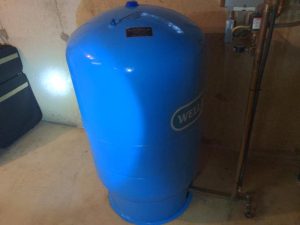
What Is the Well Pressure Tank, and Why Is It Important?
One of the components I commonly encounter during New Jersey home inspections is the well pressure tank.
These tanks are often located in basements, utility rooms, or other mechanical areas.
A pressure tank serves an important purpose. It stores a limited quantity of pressurized water and helps prevent the well pump from turning on every time someone briefly opens a faucet.
Inside many modern tanks is a diaphragm or bladder that separates the water from a compressed air chamber.
As water is used, the compressed air helps maintain pressure in the plumbing system.
Eventually, the pump activates and replenishes the tank.
Over time, pressure tanks can develop problems.
An internal bladder may fail. A tank can lose its proper air charge. Corrosion may develop, or the pressure switch may begin operating improperly.
One warning sign is frequent pump cycling.
If the pump repeatedly turns on and off during normal water use, the pressure tank or another part of the system may require corrective action.
Excessive cycling can place unnecessary wear on the well pump.
During a home inspection, I examine accessible equipment for visible deficiencies. However, determining the internal condition of the tank or the overall performance of the well system requires specialized testing.
Does Good Water Pressure Mean the Well Has an Adequate Water Supply?
Not necessarily.
This is an important distinction for New Jersey homebuyers.
A home can have excellent water pressure at the kitchen faucet without having a well capable of supplying sufficient water during periods of extended demand.
Water pressure and well yield are two different things.
Water pressure refers to the force at which water is delivered through the plumbing.
Well yield refers to the quantity of water the well can produce over time.
For example, a home may have good pressure when someone operates a single faucet.
But what happens when multiple showers are running, the washing machine is operating, and someone is using an exterior hose?
A well with limited production may struggle to meet that demand.
The pressure tank can temporarily supply water, but it cannot compensate indefinitely for an inadequate water source.
A professional well-yield or flow test can provide additional information about the well’s ability to supply water.
The appropriate testing method and duration depend on the well and the circumstances of the property.
Buyers should not assume that adequate water flow during a standard home inspection establishes the long-term capacity of the well.
Is Well Water Testing Required When Buying a Home in New Jersey?
Yes. New Jersey’s Private Well Testing Act requires water testing during qualifying real estate transactions involving private drinking-water wells.
The law is designed to provide buyers and sellers with information about the quality of the property’s drinking water.
Testing must be completed in accordance with state requirements, and both parties must receive and review the results before closing.
The required samples are collected from untreated well water.
This distinction matters because some homes have water-treatment equipment that changes the water quality before it reaches the faucets.
The purpose of the required testing is to establish the condition of the underlying water supply.
Testing is performed through properly certified laboratories and authorized sample collectors.
The New Jersey Department of Environmental Protection requires testing for specified contaminants, which may include bacteria, nitrates, certain metals, volatile organic compounds, and PFAS chemicals. The precise requirements depend partly on the property’s location.
Homebuyers can review the state’s official Private Well Testing Act information for additional details.
What Happens if the Well Water Fails Testing?
An unsatisfactory water test does not automatically mean the property cannot be purchased.
The significance depends on which contaminant was identified, its concentration, and whether an appropriate treatment solution is available.
Some water-quality concerns can be addressed through relatively straightforward treatment systems.
Others may require more extensive equipment, ongoing maintenance, or additional investigation.
It is important to understand that different treatment systems are designed to address different problems.
A water softener, for example, is primarily intended to reduce water hardness. It should not be assumed to remove bacteria, PFAS, or other contaminants unless the equipment is specifically designed and verified for that purpose.
The New Jersey Private Well Testing Act generally does not prohibit a property sale simply because a contaminant exceeds a drinking-water standard. However, local health authorities, lenders, or contractual requirements may impose additional conditions.
If testing identifies a concern, buyers should obtain an explanation of the results and determine the appropriate corrective measures and costs before closing.
What About Water Softeners and Other Treatment Equipment?
Many homes supplied by private wells have water-treatment equipment.
This may include water softeners, sediment filters, neutralizers, ultraviolet disinfection systems, or other specialized treatment devices.
The presence of this equipment does not necessarily indicate a serious water-quality problem.
Some systems are installed simply to improve taste, reduce staining, or address naturally occurring minerals.
However, buyers should understand why the equipment was installed.
For example, an acid-neutralizing system may be used to correct low-pH water that could otherwise contribute to corrosion of plumbing materials.
A water softener may be installed to address hardness that causes mineral deposits on fixtures and appliances.
Other equipment may be intended to reduce specific contaminants.
These systems require maintenance.
Filters need replacement. Water softeners require salt. Some treatment systems require periodic servicing, testing, or replacement of specialized components.
A treatment system that is installed but not properly maintained may not provide the intended results.
I recommend that buyers obtain available service records and understand the purpose and maintenance requirements of any installed water-treatment equipment.
When treatment is used to address a health-related contaminant, testing the treated water is important to verify that the system is working effectively.
How Long Does a Private Well Pump Last?
There is no single reliable lifespan for every well pump.
Service life depends on the equipment, installation quality, water conditions, operating demands, and maintenance history.
A pump that operates under favorable conditions may provide many years of service.
Another pump may fail prematurely because of electrical problems, sediment, improper installation, excessive cycling, or other conditions.
One challenge with submersible well pumps is that the equipment is installed underground.
The pump itself is not normally visible during a home inspection.
Replacing a failed submersible pump generally requires specialized equipment to remove it from the well.
Depending on the depth of the well and the circumstances, replacement can become a significant expense.
For this reason, I recommend that buyers ask about the age of the pump and whether any previous repairs or replacements have been performed.
Documentation is particularly helpful because the installation date may not be apparent from the accessible equipment inside the home.
What Does a New Jersey Home Inspector Check on a House With a Private Well?
During a standard home inspection, the interior plumbing system is examined for visible deficiencies and functional water flow.
If accessible well-related equipment is present, I may also document its general arrangement and visible condition.
For example, a pressure tank exhibiting corrosion or leakage is worth bringing to the buyer’s attention.
However, a standard New Jersey home inspection is not a comprehensive inspection of the private well.
New Jersey’s home inspection standards exclude wells, well pumps, water-storage-related equipment, water sampling, water-supply quantity and quality, and water-conditioning systems from the required plumbing inspection.
These systems require specialized knowledge, equipment, and testing procedures.
When purchasing a home with a private well, buyers should understand the difference between inspecting the accessible household plumbing and assessing the performance of the well itself.
Both are important, but they answer different questions.
Should You Have a Separate Well Inspection Before Buying?
I believe buyers should seriously consider a dedicated well-system inspection when purchasing a property supplied by a private well.
This is particularly important when the equipment is older, the service history is unknown, or there are indications of inconsistent water pressure or other operational concerns.
A qualified well contractor can assess aspects of the system that fall outside the scope of a standard home inspection.
Depending on the circumstances, this may include checking pump operation, pressure controls, the pressure tank, available service records, and well production.
Buyers should also determine whether a well-yield test is appropriate.
It is much better to understand these conditions before purchasing the property than to discover afterward that the well cannot adequately support the household’s water demands.
Questions to Ask Before Purchasing a Home With a Private Well
Before closing, I recommend obtaining answers to the following questions:
- How old is the well, and are construction records available? Well depth, installation information, and available permits can provide useful background.
- When was the well pump last replaced? Ask for invoices or service documentation.
- Has the property experienced low water pressure or inadequate water supply? Previous operating problems deserve attention.
- Has the well ever required repairs or rehabilitation? Understanding past problems may help identify recurring conditions.
- What water-treatment equipment is installed, and why? Obtain maintenance records and available testing results.
- Have the required New Jersey well-water tests been completed? Review the complete results and address any concerns before closing.
- Has the well’s production capacity been tested? If not, consider arranging appropriate testing through a qualified well contractor.
These questions can help buyers better understand the system they will be responsible for maintaining.
Frequently Asked Questions About Private Wells in New Jersey
Is buying a house with a private well a bad idea?
No. Many homes throughout Northern and Central New Jersey rely on private wells for their drinking water. A properly constructed and maintained well can provide dependable service. The important considerations are water quality, adequate production, equipment condition, and ongoing maintenance.
Does a regular home inspection include a well-yield test?
No. A standard New Jersey home inspection does not include determining the quantity of water a private well can produce. A specialized well-yield or flow test should be arranged separately when needed.
Can well water look clean but still contain contaminants?
Yes. Some contaminants cannot be identified by appearance, taste, or odor. Laboratory testing is necessary to determine whether specific contaminants are present.
Does a water softener make well water safe to drink?
Not necessarily. A conventional water softener primarily addresses hardness. It does not replace comprehensive drinking-water testing or treatment specifically designed for identified contaminants.
Who pays for private well testing during a New Jersey home purchase?
The cost is generally negotiated between the buyer and seller. The Private Well Testing Act requires qualifying testing and disclosure of results but does not automatically assign the testing expense to one party.
How often should private well water be tested after purchasing the home?
Testing should continue after the purchase. The New Jersey Department of Environmental Protection recommends regular testing, with frequency depending on the contaminants being assessed and the property’s circumstances. Its guidance includes at least annual testing for total coliform bacteria, nitrates, and pH, with additional testing at other intervals.
Final Thoughts: Understand Your Well Before You Buy
Purchasing a home with a private well should not automatically be a cause for concern.
Many private well systems provide dependable water service for years.
However, owning a private well means taking responsibility for equipment and water quality that would otherwise be managed by a municipal water utility.
A homebuyer should understand three important things before closing:
Is the water safe to drink? Can the well provide an adequate supply? Is the equipment in satisfactory condition?
These questions require different types of inspection and testing.
A standard home inspection provides valuable information about the house and its accessible plumbing system. Laboratory testing addresses drinking-water quality. A qualified well contractor can assess the well equipment and available water supply.
When buyers understand these distinctions, they are in a much better position to make informed decisions and avoid unexpected expenses after purchasing their home.
That is ultimately what a good home inspection process should accomplish: helping you understand the property before it becomes yours.
About the Author
John Martino is the owner of LookSmart Home Inspections, an independent home inspection company based in East Hanover, New Jersey. A New Jersey Licensed Home Inspector and Board-Certified Master Inspector, John serves homebuyers throughout Northern and Central New Jersey. His approach emphasizes careful observation, clear reporting, and helping buyers understand the condition of the properties they are purchasing.